
When Disorder Becomes Expression
The most compelling artists are rarely those who work from a place of inner calm and stability. More often, what we recognize as powerful artistic expression emerges from fractures within the psyche, spaces where the structure of the personality is not fully consolidated or is under strain from internal conflict. Not every fracture, however, becomes creative. The distinction lies in the individual’s capacity to transform what is disorganized and fragmented into a form that can be communicated and shared. This requires a minimal degree of internal cohesion - a sufficiently stable part of the self capable of holding the intensity of experience without either suppressing it, or becoming overwhelmed by it. Within that space, the possibility of symbolization emerges: raw, often chaotic inner states are shaped into words, images, movement, or ideas. When this capacity is absent, fragmentation remains sealed off and incommunicable, experienced as either overwhelming or empty. Creativity, therefore, does not arise from the wound alone, but from one’s relationship to it - from the ability to endure, process, and organize inner experience into something that carries structure, meaning, and the potential to be recognized by another.
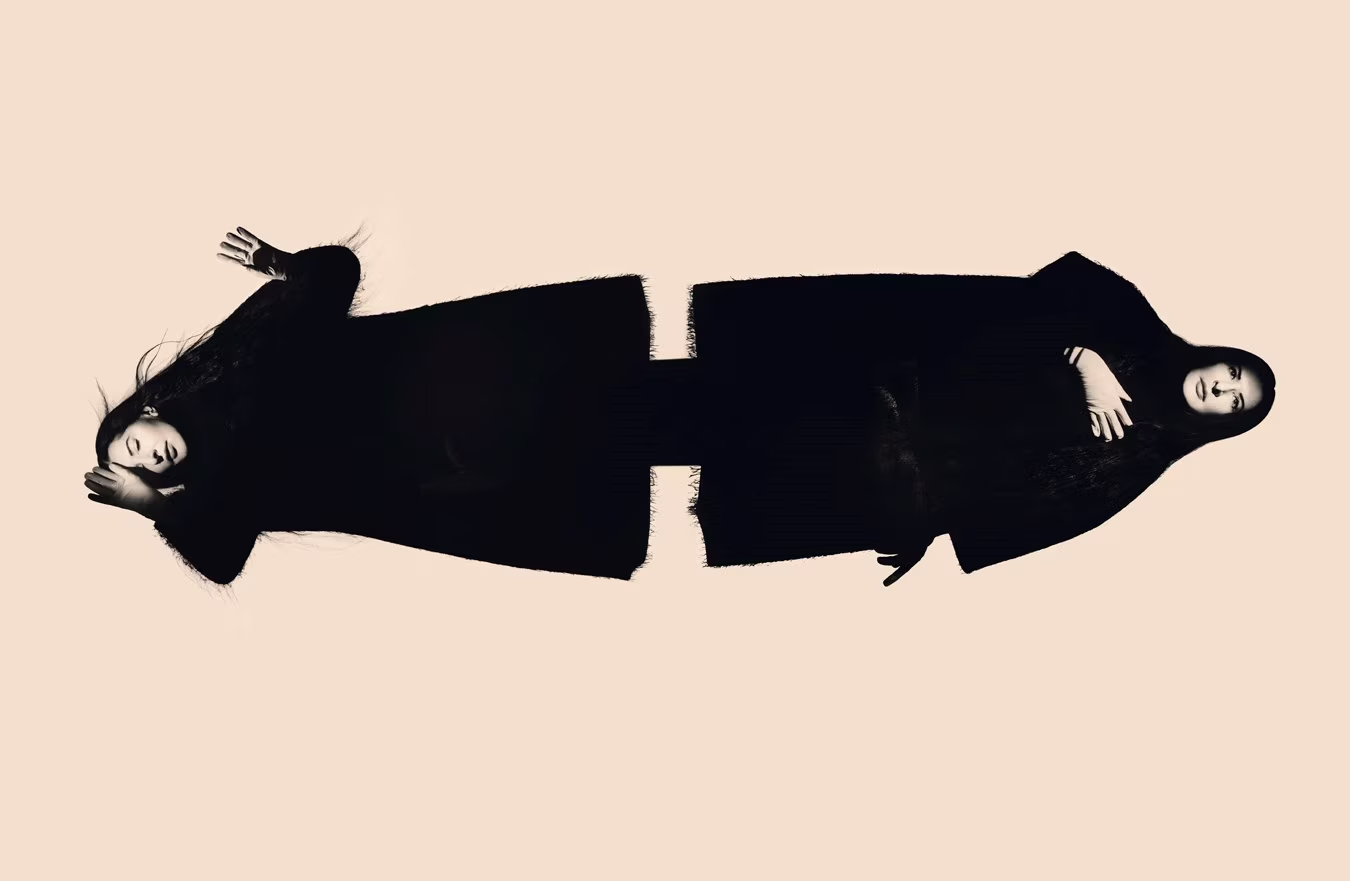
The development of the self represents a central developmental process in which emotional experience, the sense of identity, and the capacity for self-regulation are integrated, and its quality has a direct impact on psychological functioning throughout life; however, this process can be disrupted when the early environment does not provide sufficiently stable and consistent emotional mirroring and attunement. In such conditions, the child learns to adapt their behavior in order to preserve the relationship, so instead of an authentic sense of “I am,” they develop a functional but externally conditioned version of the self, what Donald Winnicott described as the false self. Although such a structure enables adaptation, it often leaves an inner experience of emptiness or an unclear sense of identity, as the authentic aspects of the self did not have the conditions to develop freely and integrate into a cohesive whole. In circumstances where the development of the self does not lead to a stable identity, the individual is left not only without a clear sense of who they are, but without continuity in that sense. This pattern gives rise to a need for constant external validation. Internal validation becomes a primary need. For those with pronounced intellectual and symbolic capacities, the lack of internal validation often becomes a driving force. The deconstruction of forms, the challenging of canons, constant shifting of positions, and the desire to shock the environment may appear as conscious aesthetic or ideological choices, but in fact serve the function of maintaining a minimal structure of the self. Such individuals shape their work in an attempt to define themselves through what they fail to establish internally. Within this process, conflict occupies a particularly important place. The reactions of others, even negative ones, provide confirmation of existence that is not stable from within. Therefore, the desire for conflict through expression does not always have a clear external cause; it is tied to an inner dynamic in which calm feels closer to emptiness than to stability. Remaining alone with one’s own identity, which could be seen as a marker of clear mental health, becomes nearly impossible here, as identity is fluctuating and, in the absence of a stable structure, sustained inwardness gives rise to anxiety, self-contempt, or an intolerable sense of emptiness. What further makes this dynamic compelling is the capacity of such artists to translate their internal state into significant artistic expression.
To continue reading, please log in or activate your subscription.